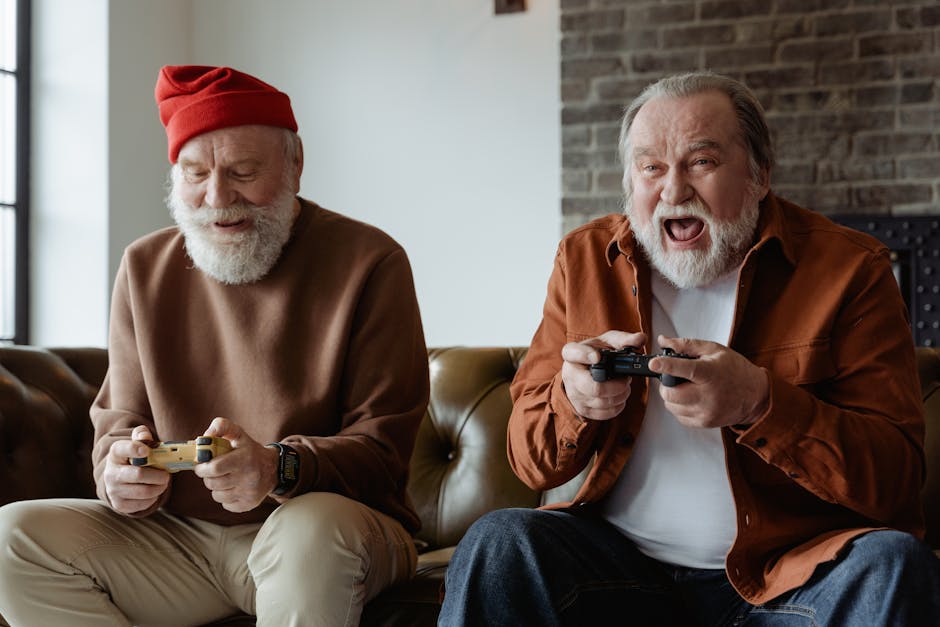
Shirley Curry began posting Skyrim videos on YouTube in 2015. She was 79 years old. Her gentle, wandering playthroughs, narrated in a warm, unhurried voice that her viewers quickly nicknamed “Grandma,” attracted a following in the millions. She became one of the most beloved gaming personalities on YouTube, not in spite of her age but in many ways because of it. Her sheer presence dismantled a stereotype that had calcified around gaming for decades.
The elder gamer is not a novelty. They are a rapidly growing demographic that the gaming industry has been consistently surprised by and consistently under-prepared to serve. Understanding who they are, why they game, and what they need from the experience is increasingly important business knowledge, not just heartwarming anecdote.
1. The Numbers the Industry Keeps Ignoring
The Entertainment Software Association’s annual reports have consistently shown that a significant portion of the gaming population is older than the industry’s marketing would suggest. Players over 36 have represented more than half of all gamers for years. The over-50 demographic has grown steadily, and the over-65 demographic, while still the smallest segment, is among the fastest-growing.
Mobile gaming is particularly significant in this context. Casual mobile games have been the primary gateway into gaming for older adults, who discovered games through smartphones they adopted for other purposes and found that certain game types fit naturally into their daily routines. Puzzle games, word games, and simple strategy games on mobile have built gaming habits in demographic groups that console and PC gaming never reached.
The financial significance of this demographic is underappreciated. Players over 50 represent a group with above-average disposable income, significant leisure time, and established spending habits that make them commercially attractive users. The assumption that older players are casual-only low-spending users is contradicted by data showing that engaged older gamers spend significantly on games and gaming-adjacent products.
2. Why Older Adults Are Gaming: The Real Motivations
The reasons older adults engage with games are more varied and more substantive than the “keeping the brain active” narrative that typically frames eldercare discussions of gaming.
Social connection is a primary motivation for many elder gamers. Gaming with adult children and grandchildren provides shared activity and conversation that bridges generational gaps in ways that other leisure activities often do not. Family gaming sessions around games like Mario Kart or Jackbox Party Packs have become a regular activity in households across demographics, with older family members participating alongside younger ones.
Cognitive engagement is genuine and well-documented, even if sometimes overstated in marketing. Research from the Max Planck Institute published in 2014 found that older adults who played Super Mario 64 for two months showed increased grey matter in regions associated with spatial navigation, strategic planning, and fine motor skills. Puzzle games, strategy games, and narrative games provide genuine cognitive challenge that many older players actively seek.
Entertainment and escape are motivations that the industry sometimes forgets to take seriously for older audiences, perhaps because it does not fit the narrative of gaming as a young person’s activity. Older adults enjoy games for the same reasons people of all ages do: they are engaging, entertaining, and provide a form of absorption and enjoyment that enhances daily life.
3. The Barriers That Have Kept Elder Gamers Out
Despite growing participation, older adults face genuine barriers to gaming participation that the industry has been slow to address.
Control complexity is perhaps the most significant. Modern game controllers have evolved over decades in ways that assume embodied familiarity built through years of gaming. A player who has never used an analog stick lacks the muscle memory that makes its use feel intuitive. Controllers with many buttons, complex input combinations, and precision requirements that assume fine motor skills that may have changed with age create immediate friction for new older players.
Visual and auditory design that assumes young eyes and ears creates accessibility barriers that compound the control challenge. Small text, low-contrast color schemes, fast-moving visual information, and quiet audio relative to sound effects are all common in games designed without older players in mind.
Cultural unwelcomeness, while diminishing, remains a factor. Gaming spaces and gaming culture have historically been oriented toward younger audiences in ways that can feel unwelcoming to older participants. The assumption that gaming is for the young, while increasingly inaccurate, persists in marketing, in game design, and in community culture in ways that create psychological barriers alongside practical ones.
4. The Games That Elder Gamers Love and Why
The games that have found the largest elder gaming audiences share characteristics that are worth understanding as design signals rather than genre coincidences.
Stardew Valley’s gentle pace, clear objectives, lack of failure states that are punishing, and atmosphere of warmth and productivity have made it one of the most beloved games among older players. Its design is accessible without being simplistic and engaging without being demanding in ways that conflict with the experience profile of older adults.
Puzzle games across mobile and PC have broad elder gaming audiences because they offer cognitive engagement with intuitive mechanics and natural session lengths. The success of the New York Times Games suite, including Wordle, Spelling Bee, and Crossword, with older demographics demonstrates that this audience actively seeks quality puzzle experiences.
Life simulation games like The Sims have maintained large older adult audiences for decades. The absence of failure conditions, the creative and constructive nature of the gameplay, and the connection to domestic and social themes that resonate across life stages make this genre particularly accessible.
5. The Social Gaming Revolution Among Older Adults
One of the most significant developments in elder gaming is the growth of gaming as a social activity specifically designed for and within older adult communities.
Gaming programs in assisted living facilities have grown substantially, with research documenting benefits for both cognitive engagement and social connection among participants. Activities directors at senior communities report that gaming sessions, particularly with accessible equipment and games, produce higher levels of engagement and enjoyment than many traditional activities programming.
Online communities of older gamers have formed on every major platform, creating social contexts where age is a shared rather than isolating characteristic. YouTube communities around gaming personalities like Shirley Curry attract older viewers who see themselves represented and feel welcomed rather than tolerated.
Game developers targeting older demographics have found engaged and loyal audiences. The growing market for games designed around the interests and experience profiles of older players, from historical strategy games to gardening simulations to word puzzle games, reflects genuine commercial opportunity that mainstream gaming has largely left untapped.
6. What the Industry Must Change to Serve This Audience
Serving elder gamers well requires design changes that are often the same changes that improve games for everyone but matter most for older players.
Adjustable text size, high-contrast display options, and scalable UI elements should be standard features, not exceptions. Remappable controls that allow any input to be configured for individual physical needs address control accessibility without requiring specialized hardware. Adjustable game speed and optional assistance features allow games to accommodate different ability profiles without compromising the experience for players who prefer standard settings.
Marketing that represents older players as normal gaming audience members rather than novelties would both reflect reality and signal welcome. The invisibility of older adults in gaming marketing contributes to the cultural assumption that gaming is not for them, which in turn suppresses participation from people who might otherwise engage.
7. The Multigenerational Gaming Future
The rise of elder gamers is not a story about a separate audience to be served with specialized products. It is a story about gaming becoming genuinely multigenerational in ways that transform what games can mean in family and community life.
When a grandparent and grandchild share a gaming experience, something happens that most other entertainment forms cannot create: genuine co-participation in a shared challenge rather than parallel consumption of the same content. The multigenerational gaming session, already common in millions of households, represents a use of gaming that the industry has rarely designed for deliberately and that represents significant untapped value.
Games designed to be genuinely accessible across age groups, that can be enjoyed by a ten-year-old and their seventy-year-old grandparent without either being bored or excluded, are rare and when they exist they are enormously popular. Mario Kart, Minecraft, and Nintendo Switch Sports all approximate this ideal to varying degrees. The market for games that genuinely achieve it is far larger than what currently serves it.
Conclusion
The rise of elder gamers is dismantling one of the last demographic stereotypes attached to gaming. Age is no longer a barrier for the millions of older adults who have discovered that games offer engagement, connection, and enjoyment regardless of when they first picked up a controller. The industry that recognizes this, designs for it, and markets to it honestly will find a commercially significant and personally rewarding audience that has been waiting to be welcomed in. Shirley Curry knew this before most of the industry did. Five million YouTube subscribers agreed with her.
Last modified: February 12, 2026