In 2018, a gamer named Steve Saylor posted a video titled “Blind Gamer Plays God of War.” Steve has low vision caused by a congenital condition and cannot see most of what happens on a typical game screen. He had largely given up on action games because they were designed without any consideration for players with his visual profile.
God of War 2018 changed that. Not because it was designed specifically for low-vision players, but because Sony Santa Monica had implemented audio cues, high-contrast options, and adjustable UI elements that collectively made the game meaningfully playable for Steve in a way that comparable games were not. His video went viral. Sony Santa Monica was praised widely. And an industry that had treated accessibility as a niche concern began to reckon with both its failures and its opportunities.
1. The Scale of the Excluded Audience
The business case for gaming accessibility starts with a number most publishers have historically ignored. According to the World Health Organization, approximately 1.3 billion people worldwide live with some form of disability. Even applying conservative estimates about the proportion who play or would like to play games, the accessible gaming audience is enormous and substantially underserved.
The Able Gamers Foundation, which advocates for accessible game design and provides hardware solutions for players with physical disabilities, estimates that approximately 46 million gamers in the United States alone have some form of disability. That figure represents a significant segment of the gaming market that current design practices systematically exclude.
Beyond the permanently disabled population, accessibility features serve a much broader group. Players with temporary injuries, older players experiencing age-related changes in vision or motor function, players in environments where audio is unavailable, and players with situational limitations like holding an infant while gaming all benefit from accessibility options. Features designed for disability serve everyone in conditions where they need them.
2. The Spectrum of Accessibility Needs in Gaming
Gaming accessibility is not a single challenge. It encompasses a wide spectrum of needs that require different design solutions.
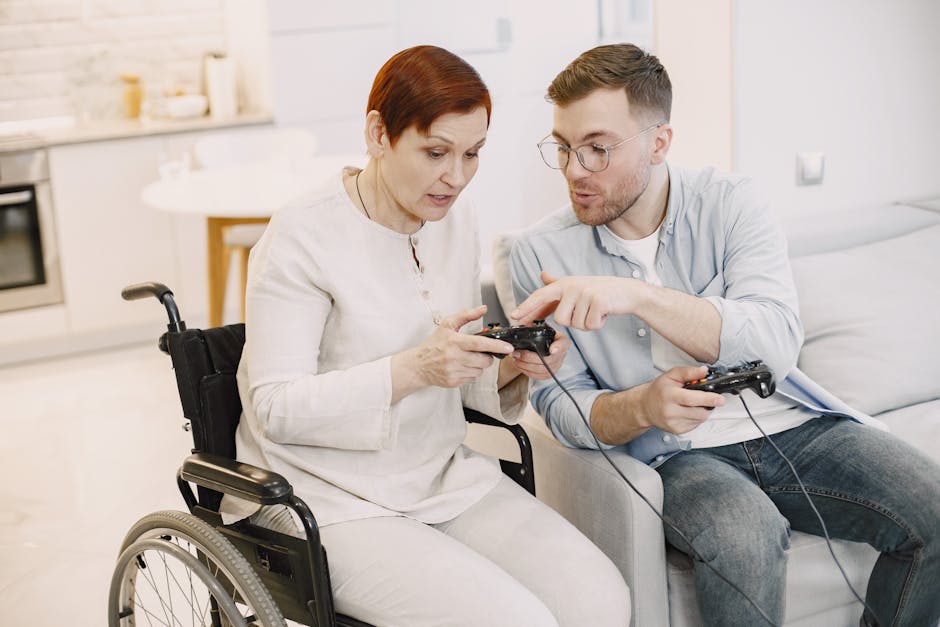
Motor accessibility addresses the needs of players who cannot use standard controllers or who have limited range of motion, strength, or precision. This includes players with conditions like cerebral palsy, muscular dystrophy, spinal cord injuries, and limb differences. Solutions range from remappable controls, which allow any input to be assigned to any button, to support for alternative input devices like eye trackers, switch controllers, and breath-controlled devices.
Visual accessibility addresses players who are blind, have low vision, or have color vision deficiencies. Solutions include screen reader compatibility, audio description of visual events, high-contrast display modes, adjustable text sizes, and color-blind modes that replace color-dependent information with shapes or patterns.
Hearing accessibility addresses players who are Deaf or hard of hearing. Solutions include subtitles and closed captions for all spoken dialogue, visual indicators for audio cues like enemy footsteps or incoming attacks, and sign language options in some games. The quality of subtitle implementation varies enormously across games, with the best implementations including speaker identification, sound effect descriptions, and adjustable size and positioning.
Cognitive accessibility addresses players with learning disabilities, attention difficulties, or cognitive processing differences. Solutions include adjustable game speed, clear and consistent information presentation, dyslexia-friendly font options, and content warnings for players with specific sensitivities.
3. The Games That Raised the Bar
A series of landmark accessibility implementations in major games has established what best practice looks like and raised player expectations across the industry.
The Last of Us Part II, released in 2020, is widely considered the most comprehensively accessible major game ever released. It includes over 60 accessibility options covering motor, visual, hearing, and cognitive needs. A blind player named Brandon Cole completed the game using its audio description and navigation assistance features and documented his experience in a video that demonstrated the practical impact of serious accessibility investment. The game’s accessibility lead, Matthew Gallant, has since spoken and written extensively about the design process, contributing to industry knowledge about how to do this work well.
Microsoft’s approach to accessibility across its Xbox platform has been consistently praised. The Xbox Adaptive Controller, launched in 2018, provides a large-button controller designed to work with a wide range of alternative input devices, making console gaming accessible for players who cannot use standard controllers. The product was developed in close partnership with disability communities and advocacy organizations and won multiple design awards including recognition from the Museum of Modern Art.
Forza Horizon 5’s comprehensive hearing accessibility implementation, which includes audio descriptions of visual elements and ASL and BSL video introductions, received specific praise from the Deaf gaming community as an example of accessibility implemented with genuine understanding of community needs rather than minimal compliance.
4. The Accessibility Advocates Who Drove Change
The improvements in gaming accessibility did not emerge from industry initiative alone. They emerged from sustained advocacy by disabled gamers, accessibility researchers, and organizations dedicated to making gaming more inclusive.
AbleGamers, founded in 2004, has provided gaming equipment, advocacy, and industry consultation for decades. Its Accessible Player Experiences framework provides game developers with practical guidance for implementing accessibility features. The organization’s work with developers has directly influenced accessibility implementations in major games.
SpecialEffect, a UK-based charity, provides customized gaming technology solutions for people with severe physical disabilities and works with developers to improve accessibility in mainstream titles. Its annual GameBlast fundraising event has raised millions of pounds and generated significant media coverage of gaming accessibility issues.
Individual disabled advocates, including Steve Saylor, Brandon Cole, and Cherry Thompson, who has written extensively about gaming accessibility, have created content and community conversation that made the abstract stakes of accessibility design concrete and personal. Their work demonstrated to developers and publishers that there was an engaged, vocal, and deserving audience for accessible games.
5. The Business Case That Publishers Are Finally Accepting
The accessibility conversation in gaming has historically been framed as a cost-benefit question that accessibility advocates found frustrating. Implementing accessibility features requires development resources. Publishers weighed those resources against the perceived size of the accessible gaming audience and frequently concluded the investment was not worthwhile.
That calculation has changed for several reasons. The audience for accessible features is much larger than the permanently disabled population alone, as noted above. The goodwill generated by strong accessibility implementation translates into media coverage, social media sharing, and community advocacy that has real marketing value. And the reputational cost of being publicly identified as inaccessible, in an era when disabled gaming advocates have significant reach, is increasingly visible.
Microsoft’s research found that accessibility features were used by a significant portion of players, including many without disabilities who found them useful in specific contexts. This finding, that accessibility features are general usability improvements rather than specialized accommodations, has changed how some publishers think about the return on accessibility investment.
6. The Technical Infrastructure Being Built
As accessibility has become a higher priority, the technical infrastructure for implementing it is improving, making it progressively easier and less expensive for developers to include comprehensive accessibility options.
Game engines are increasingly including accessibility tools as built-in capabilities rather than requiring custom implementation. Unreal Engine and Unity, the two dominant game engines, have both invested in accessibility tooling that makes common accessibility features easier to implement without specialized expertise.
The Game Accessibility Guidelines, an industry resource developed collaboratively by game developers and accessibility specialists, provide practical, prioritized recommendations that help development teams identify which accessibility features to implement and how. The resource reduces the need for every team to start from first principles.
Third-party accessibility testing services staffed by disabled gamers provide evaluation that identifies gaps in accessibility implementation before games ship. This testing is analogous to quality assurance testing for gameplay, ensuring that accessibility features work as intended for the players who depend on them.
7. What Genuine Inclusion Looks Like Going Forward
The accessibility revolution in gaming is real but incomplete. Major releases still ship with inadequate accessibility implementations. Multiplayer competitive games have historically lagged single-player games in accessibility investment. Mobile gaming has accessibility implementations that trail console and PC significantly. And the quality of accessibility features varies enormously even among games that claim accessibility support.
The standard that the industry’s best work has established is clear: comprehensive accessibility means covering motor, visual, hearing, and cognitive needs; involving disabled players in design and testing rather than designing in their absence; and treating accessibility as a core design consideration rather than a post-launch addition.
Games that treat accessibility as an afterthought are increasingly being held to account by vocal disabled gaming communities with significant reach and by review coverage that now routinely addresses accessibility implementation. The incentive structure is shifting.
Conclusion
The accessibility revolution in gaming is changing who can play, what games feel like for players who have historically been excluded, and how the industry thinks about the relationship between design quality and inclusion. The games that have led this revolution have demonstrated that comprehensive accessibility implementation is technically achievable, commercially valuable, and the right thing to do. The revolution is not complete, but its direction is clear and its momentum is real. The gaming industry is slowly but genuinely becoming more accessible, and the players who benefit from that change are reminding everyone else why it matters.
Last modified: August 16, 2026