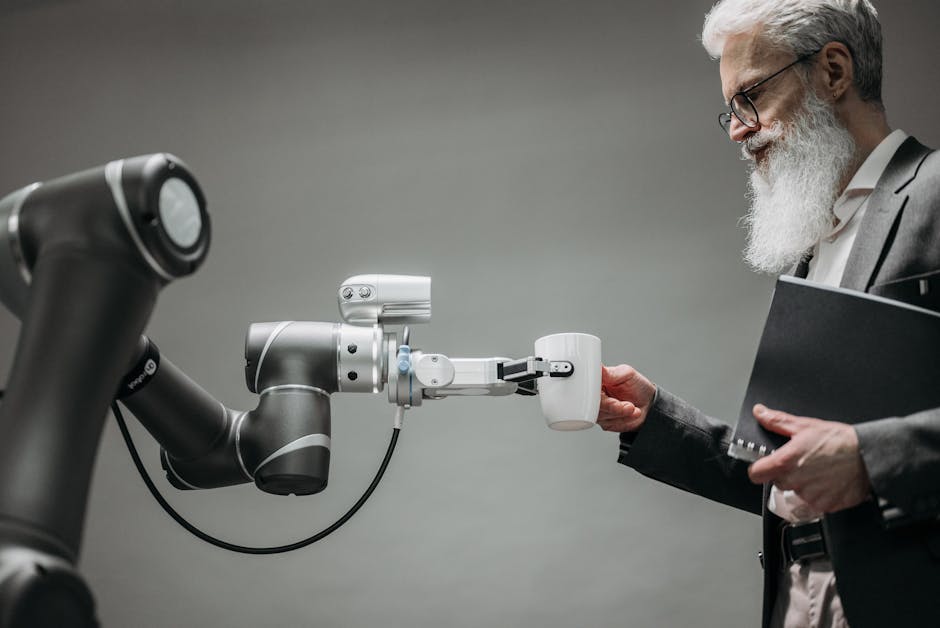
The conversation about AI and employment has been dominated by one question: which jobs will AI replace? It is the wrong question. The more accurate and more useful question is: how is AI changing what it means to do a job well? Because the evidence increasingly points not toward mass replacement but toward something more nuanced and more interesting. A new category of worker is emerging, one who combines human judgment with AI capability in ways that make them dramatically more productive than either could be alone.
These are augmented workers. And understanding how they operate, what skills define them, and how organizations can develop them is one of the most important strategic questions in business right now.
1. What Augmented Work Actually Looks Like
Augmented work is not simply using AI tools. Most knowledge workers use some form of AI assistance already, from autocomplete in email to AI-powered search. Augmented work is something more integrated and more deliberate.
An augmented worker treats AI as a genuine collaborator rather than a faster search engine. They know when to delegate a task to an AI system, how to evaluate and refine the output, where human judgment must override the AI’s suggestion, and how to combine AI-generated work with human insight to produce something neither could create independently.
A marketing strategist who uses AI to analyze campaign performance data, generates multiple creative directions with AI assistance, then applies their understanding of the client’s brand and audience to select and refine the best direction is working in an augmented mode. The AI accelerates the mechanical work. The human provides the contextual judgment that makes the output genuinely useful.
2. The Productivity Gap Between Augmented and Non-Augmented Workers
Research on AI-assisted work is producing consistent findings: the productivity gap between workers who effectively use AI tools and those who do not is large and growing. A 2023 study by researchers at MIT found that workers using AI assistance on writing tasks completed them 37% faster and produced work that independent evaluators rated as 18% higher quality.
Studies of AI assistance in coding, customer service, and legal research have produced similar directional findings. The workers who benefit most are not necessarily the highest performers to begin with. In several studies, AI assistance produced the largest gains for mid-level performers, compressing the gap between average and excellent rather than simply making excellent workers faster.
This has significant implications for how organizations think about talent development. The question is no longer only who has the most raw capability, but who has the capability to effectively partner with AI systems and multiply their own output through that partnership.
3. The Skills That Define Effective Augmented Workers
Effective augmented work requires a specific set of skills that are distinct from both traditional professional expertise and technical AI knowledge. You do not need to understand how a language model works to use one effectively, any more than you need to understand combustion engineering to drive a car effectively.
Prompt literacy is the foundational skill: the ability to communicate intent clearly to AI systems and to iterate toward better outputs through progressively refined instructions. This is partly a writing skill and partly a thinking skill. Workers who can decompose complex tasks into clear instructions and evaluate AI outputs critically tend to be far more effective AI collaborators than those who treat AI as a black box that either works or does not.
Critical evaluation is equally important. AI systems produce confident-sounding outputs that are sometimes wrong, sometimes outdated, and sometimes subtly biased by their training data. Augmented workers must be capable of evaluating AI outputs with appropriate skepticism rather than accepting them uncritically. This requires domain knowledge deep enough to recognize when something is plausible but incorrect.
Workflow integration completes the skill set. The most productive augmented workers have thought carefully about which parts of their work benefit from AI assistance and which require unmediated human judgment. They have developed personal systems for incorporating AI into their workflows without creating new bottlenecks or quality risks.
4. What Organizations Must Do to Develop Augmented Workers
Most organizations are doing far too little to develop augmented work capabilities in their teams. Providing access to AI tools is not the same as developing the skills to use them effectively. Many organizations have done the first without doing the second and are disappointed that productivity gains are not materializing at scale.
Effective augmented worker development requires three organizational investments. Training that goes beyond tool orientation and addresses the judgment skills of critical evaluation, effective prompting, and workflow integration. Permission to experiment, including tolerance for the time it takes to develop AI-assisted workflows before they become efficient. And cultural normalization of AI assistance, so that workers do not feel that using AI reflects negatively on their skills or threatens their job security.
Organizations that create environments where augmented work is supported, taught, and normalized will develop significant productivity advantages over those that provide tools without the surrounding support structure.
5. The Roles Being Transformed Most Rapidly
While AI augmentation is affecting virtually every knowledge work category, some roles are being transformed more rapidly and more fundamentally than others.
Software developers are experiencing one of the most significant augmentations. AI coding assistants can generate functional code from natural language descriptions, suggest completions, identify bugs, and explain unfamiliar codebases. Developers who use these tools effectively are reporting productivity improvements that make individual developers capable of work that previously required small teams.
Analysts and researchers are experiencing similar transformation. AI systems can process and synthesize large volumes of information, identify patterns in datasets, and generate preliminary analyses that would have taken days of manual work. The analyst’s role shifts from information gathering and processing toward interpretation, judgment, and strategic recommendation.
Writers, marketers, lawyers, and medical professionals are all experiencing augmentation at different intensities. In each case, the pattern is similar: AI handles the mechanical and informational heavy lifting while human expertise drives the judgment, contextualization, and quality assurance that makes the output genuinely valuable.
6. The New Management Challenge: Leading Augmented Teams
Managing augmented workers requires a different approach than managing traditional knowledge workers. The output quality of an augmented worker depends not just on their domain expertise but on the quality of their AI collaboration. Managers who cannot evaluate the quality of that collaboration are flying blind.
This creates a new management skill requirement: enough familiarity with AI tools and augmented workflows to assess whether a team member is using them effectively or whether they have developed habits that look productive but produce low-quality outputs that human reviewers have not been catching.
It also requires rethinking performance metrics. Measuring inputs, such as hours worked and tasks completed, becomes even less meaningful when AI assistance dramatically changes the relationship between effort and output. Measuring outputs and outcomes, along with the quality of judgment applied to AI-assisted work, becomes more important than measuring the work process itself.
7. Preparing Now for the Augmented Workforce Future
The window for developing augmented work capabilities ahead of competitive pressure is narrowing. Organizations that develop these capabilities now will have a significant lead over those that wait until AI augmentation is an obvious strategic necessity.
For individual workers, the imperative is equally clear. The workers who develop effective AI collaboration skills now are building professional leverage that will compound over time. The workers who resist or ignore this shift are not protecting their current role. They are gradually making themselves easier to replace, either by AI systems directly or by colleagues who have learned to work effectively with AI tools.
Conclusion
The augmented worker is not a futuristic concept. They are already in every organization, outperforming their non-augmented colleagues in ways that are beginning to show up in business outcomes. The rise of human-AI hybrid roles is not the story of technology replacing human workers. It is the story of technology amplifying human judgment, creativity, and expertise in ways that make the humans who embrace it more valuable, not less. The question is not whether to become an augmented worker. It is how quickly you develop the skills to do it well.
Last modified: June 8, 2026