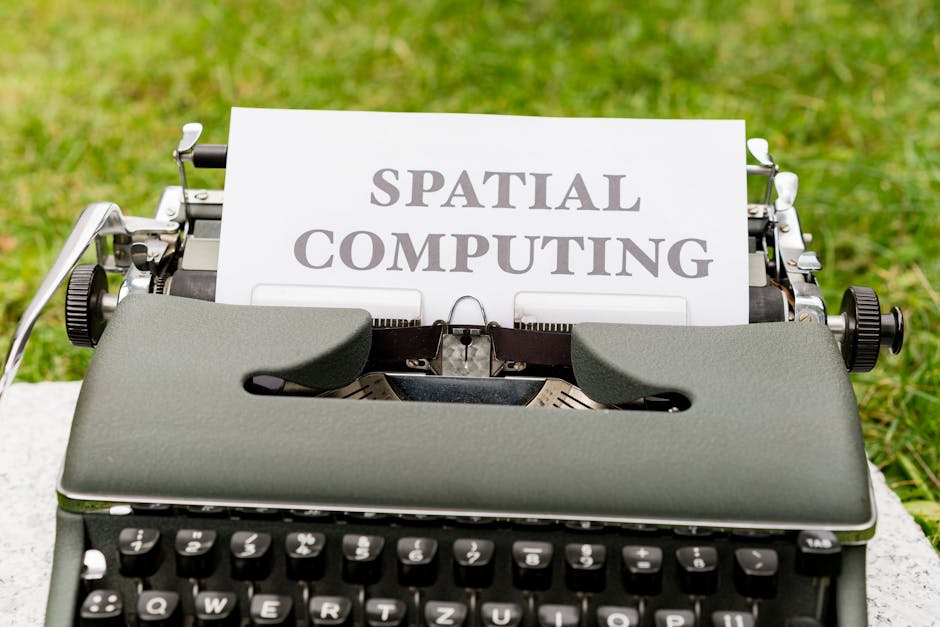
The internet has always been a metaphor. We talk about going online, visiting websites, navigating pages. But the experience has remained fundamentally flat: a screen, a cursor, a two-dimensional representation of information. The spatial web is the transition from the internet as a surface you look at to the internet as an environment you inhabit.
This is not a distant science fiction scenario. The technologies enabling it are converging right now, and the businesses, designers, and entrepreneurs who understand the spatial web early will have a significant advantage in the decade ahead.
1. What the Spatial Web Actually Means
The spatial web refers to a layer of digital information and experience mapped onto the physical world and navigable in three dimensions. It combines augmented reality, virtual reality, artificial intelligence, and persistent data infrastructure to create environments where digital and physical information coexist in the same space.
In its most accessible current form, the spatial web shows up in AR navigation overlays, where directions appear as arrows floating in the real world through a phone camera. In more developed forms, it appears in industrial applications where technicians see maintenance instructions overlaid on the equipment they are servicing, or in retail where customers see how furniture would look in their actual rooms before purchasing.
The full realization of the spatial web is an environment where every physical location has a persistent digital layer: information, experiences, commerce, and communication attached to places rather than to separate screens. Walking into a city becomes walking through both a physical and digital landscape simultaneously.
2. The Technologies Converging to Make It Real
No single technology is creating the spatial web. It is emerging from the convergence of several independently advancing fields reaching sufficient maturity at roughly the same time.
Spatial computing hardware is the most visible enabler. Devices like Apple Vision Pro, launched in 2024, and a growing range of augmented reality glasses are creating consumer-accessible hardware capable of overlaying digital information on the physical world with increasing precision and naturalness. As these devices become lighter, more affordable, and more capable, they shift from novelty products to everyday interfaces.
Computer vision and simultaneous localization and mapping, known as SLAM, allow devices to understand their physical environment in real time, recognizing surfaces, objects, and spatial relationships accurately enough to anchor digital content convincingly to physical locations. This technical capability is what makes digital objects appear to sit on real tables and virtual navigation arrows appear to float above real streets.
Persistent world infrastructure, which involves the databases and protocols that store and serve spatial data at scale, is the less visible but equally important enabler. For a digital layer to be meaningfully attached to physical locations, there must be infrastructure that knows what digital content belongs where, serves it with low enough latency to feel real, and allows multiple users to experience the same spatial data simultaneously.
3. Where the Spatial Web Is Already Delivering Value
The spatial web is not waiting for consumer adoption to prove its value. Several sectors are already seeing significant returns from spatial computing applications.
Manufacturing and maintenance represent one of the strongest current applications. Companies including Boeing and Volkswagen have deployed AR systems that overlay assembly instructions and quality checkpoints onto physical workspaces, reducing errors and training time for complex manufacturing processes. Workers see exactly what needs to be done at each step without consulting separate documentation or diverting attention from the physical task.
Healthcare is another high-value early adopter. Surgical navigation systems that overlay patient imaging data onto the surgeon’s field of view during procedures are in active clinical use. Medical training applications using spatial computing allow trainees to practice procedures in three-dimensional environments that replicate the spatial reality of actual anatomy more effectively than flat screen simulations.
Architecture and construction use spatial computing to overlay building information models onto construction sites, allowing workers to see precisely where pipes, electrical conduits, and structural elements should be placed without consulting two-dimensional drawings that require spatial translation.
4. The Commercial Opportunity for Entrepreneurs
The spatial web creates commercial opportunities across a wide range of categories, most of which are still in early stages of development.
Spatial commerce is perhaps the most immediately significant. The ability to experience products in the actual context where they will be used, whether furniture in a real room, clothing on a real body, or equipment in a real workspace, removes one of the primary uncertainties that creates friction in online purchasing. Brands that build compelling spatial commerce experiences will convert browsers to buyers more effectively than those relying solely on flat images and descriptions.
Spatial advertising is an emerging category with significant questions about user experience and privacy still to be resolved. Location-aware digital content that appears as part of a spatial layer creates entirely new formats for commercial messages. The challenge is creating formats that feel like useful information rather than intrusive interruption.
Spatial collaboration tools are growing in relevance as distributed work becomes permanent for many organizations. Environments where remote colleagues appear as spatial presences rather than video windows, where three-dimensional objects can be manipulated collaboratively, and where the sense of shared space makes remote collaboration feel meaningfully different from a video call represent a significant commercial opportunity.
5. The Standards Battle Shaping the Spatial Web
One of the most important but least visible dynamics in the spatial web’s development is the competition to establish the standards and protocols that will define how spatial data is created, stored, shared, and rendered. This standards battle will determine which companies control the infrastructure layer of the spatial web in the same way that browser standards, search algorithms, and app store policies shaped the control architecture of the current web.
Several competing initiatives are working to establish open standards for spatial computing. The Khronos Group’s OpenXR standard aims to create a common interface between spatial applications and hardware devices. The Open Geospatial Consortium is developing standards for how spatial data is represented and shared. Web standards bodies are working on extensions to web technologies that would enable spatial experiences through browsers.
The outcome of these standards competitions matters enormously for the openness and commercial structure of the spatial web. A spatial web built on open standards will look very different, and create very different commercial opportunities, than one controlled by proprietary platforms operated by a small number of large technology companies.
6. Privacy and the Spatial Web
The privacy implications of the spatial web are more significant than those of any previous internet evolution. A spatial computing environment requires devices to continuously map and understand the physical world, including the spaces, objects, and people within them. The data generated by this continuous environmental scanning is extraordinarily sensitive.
Who has access to spatial maps of private homes where AR devices are used? What happens to biometric data generated by devices that track eye movement and facial expression as part of their interaction model? How is location and behavior data protected when spatial computing devices know not just where a user is but what they are looking at and doing?
These questions do not have fully resolved answers yet. The regulatory frameworks being developed for AI and data privacy are beginning to address spatial computing, but they lag behind the technology’s deployment. Entrepreneurs building spatial web applications who take privacy seriously now, by collecting only what is necessary, storing it securely, and giving users genuine control over it, will be better positioned for the regulatory environment that is forming.
7. Preparing for the Spatial Web Transition
For businesses not in the technology sector, the spatial web transition creates preparation questions that are worth addressing before the technology reaches mainstream adoption. How will your customer experience change when customers can interact with your products spatially before purchasing? How will your operational processes be enhanced by spatial computing tools? What spatial data about your physical locations and products would provide value to customers or employees?
Starting with a single high-value application rather than a comprehensive spatial strategy is the most practical approach for most businesses. Identify the one interaction in your customer journey or your operations where spatial computing would provide the clearest value, build competence there, and expand from a position of demonstrated success.
Conclusion
The spatial web represents the most fundamental evolution of the internet since the transition from desktop to mobile. It changes the internet from a destination people visit to an environment they inhabit, layering digital experience onto physical reality in ways that will reshape commerce, work, communication, and entertainment. The transition is not instantaneous, but it is underway. The entrepreneurs and businesses that engage with it now, while it is still forming, will have advantages that those who wait for full mainstream adoption will not be able to replicate.
Last modified: September 5, 2026